

Posted: Monday, January 9, 2012 11:00 am
ourenglewoodnews.com
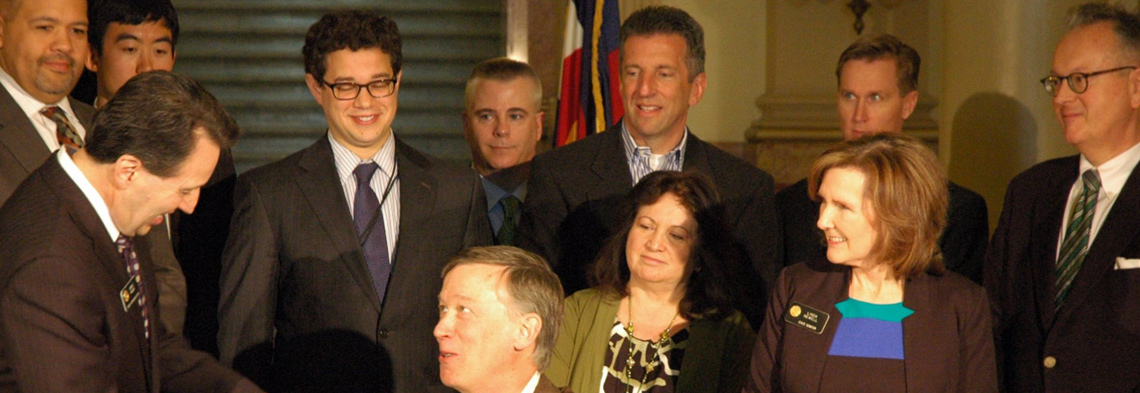
State Rep. Daniel Kagan, D-Cherry Hills, provides the opening remarks at his Jan. 5 town meeting at Veterans of Foreign Wars Post 9644. About 30 people attended the meeting as Kagan talked about establishing a favorable climate so existing businesses can grow and new businesses will be attracted to the state. As part of the presentation, two guests from the governor's office focused on issues surrounding jobs and job creation. Photo by Tom Munds
Proposed Bill from Colorado House Democrat Mandates Sharing Jobs Data With Schools
POSTED: 01/09/2012 01:00:00 AM MST UPDATED: 01/09/2012 08:19:01 AM MST
By Jessica FenderThe Denver Post
Read more:Proposed bill from Colorado House Democrat mandates sharing jobs data with schools - The Denver Posthttp://www.denverpost.com/recommended/ci_19702480#ixzz1j59oVuHy Read The Denver Post's Terms of Use of its content: http://www.denverpost.com/termsofuse
Backers of a proposed jobs bill from state House Democrats hope a simple concept can better direct students into the fields of study most attractive to Colorado companies.
Rep. Daniel Kagan, D-Cherry Hills Village, on Sunday unveiled a draft bill that would direct the Department of Labor — which collects data on job openings — to share that information with colleges, vocational schools and workforce training programs.
Colleges and training programs would also be directed to publicly report the skills their most recent graduates have to offer, should the Skills for Jobs Act pass.
"Companies sometimes have a hard time finding well-qualified applicants to fill jobs, and Colorado's well-qualified applicants are having a hard time finding those companies," Kagan said. "This bill seeks to bridge that gap."
Kagan hopes the sharing of information can be accomplished at no additional cost to taxpayers, he said.
Metro State president Stephen Jordan said the bill could prompt schools like his to tweak existing programs to better match the job market — or to develop new programs entirely.
It could also give people who already have degrees a better idea of the additional certificates or training they need to jump into emerging markets, Jordan said.
Jordan said he envisions adding minors or certificates that prepare students for the niches in their areas of interest that most need workers.
"Someone could come back and get specialized," Jordan said. "That's an area that higher ed can respond very quickly to."
House Minority Leader Mark Ferrandino, D-Denver, said the Skills for Jobs Act is just one of an array of bills from his caucus aimed at putting people back to work.
The 2012 legislative session opens Wednesday.
"This session, House Democrats will have a laserlike focus on firing up this economy and creating good jobs," Ferrandino said. "We will work with any legislator, any business owner, any labor leader and anyone with a good idea."
Warm holiday greetings to you and your family! Since the end of the 2011 legislative session, events have been unfolding thick and fast; legislative district boundaries have been redrawn, improved forecasts have been issued by our legislative economists and the state’s public school finance system has been declared unconstitutional, to name just three. I discuss these developments and invite you to tell me your thoughts about them (www.dankagan.com , (720) 519-1319,
This e-mail address is being protected from spambots. You need JavaScript enabled to view it
) in this pre-session newsletter.
House District 3 Sees Important Changes
Every ten years, after each census, legislative district boundaries are redrawn to account for population shifts over the previous decade. This has brought substantial change to House District 3. Currently, our district includes south-central Denver, Cherry Hills Village and most of Englewood (see current district map). The Colorado Supreme Court has now confirmed that, beginning in 2013, the district will lose all of its Denver precincts but will add those parts of Englewood not currently within the district, all of Greenwood Village and Sheridan, the northern part of Littleton (north of West Littleton Boulevard), and northern Arapahoe County as far east as Cherry Creek State Park (see future district map). It is important to note that until January 2013, I will continue to represent the current House District 3, so if you are one of my Denver constituents I will still be working for you throughout 2012.
The State’s Finances Are Improving
On December 20, 2011, our legislative economists reported that the state’s financial condition and prospects are improving, though the pace of progress is slower than any of us would like. The 2010-11 General Fund is in surplus, allowing us to transfer $221 million to the State Education Fund (Senate Bill 11-156) and $67 million to the State Public School Fund (Senate Bill 11-230). For the current fiscal year (FY 2011-12) General Fund revenue is expected to exceed the amount budgeted by $148 million and, if that surplus is carried forward to the following year (FY 2012-13), revenue is forecast next year to exceed appropriations by $470 million. Crucial to understanding these figures are the assumptions that the economy performs as forecast and events in Europe do not undermine the slow recovery now underway. Most importantly, the figures do not account for inflation or caseload growth, both of which are almost certain to occur. Nevertheless, it is encouraging to learn that the state appears in better financial shape now than it appeared three months ago. Colorado businesses are again hiring, though not quickly enough; I will do everything possible in the 2012 session to encourage job creation and continued economic growth.
School Finance System Declared Unconstitutional
In what could turn out to be a very significant development, a Colorado District Court has ruled that the state’s public school finance system is unconstitutional (Lobato v. State of Colorado). The decision is subject to appeal and possible reversal by the Colorado Supreme Court, but, as of now, our state’s school finance system is authoritatively said to be irrational and underfunded by as much as one to four billion dollars per year. The constitution requires the state to provide a “thorough and uniform” system of public education with a significant measure of local control. This, the court says, we fail to do, largely because we don’t appropriate sufficient funds to meet the constitution’s requirements.
The court left it to the legislative branch to devise a remedy. It specified also that legislative action can wait until appeals have been exhausted or, if there is no appeal, then at least until after the 2012 legislative session.
There is no constitutional requirement, therefore, for immediate action by the General Assembly, but that does not mean, in my view, that we can blithely ignore the Lobato decision in the upcoming session. I believe it would violate the spirit, if not the letter, of the decision if we were to impose further cuts on the K-12 education system. The least we can do, with a clear conscience and in conformity with our constitutional oath, is to maintain the already inadequate funding levels we currently have. I intend to accept no less.
Some Of My Bills For 2012
The 2012 legislative session begins on January 11th, so I have already begun drafting legislation that I plan to introduce next month. This includes a bill to protect babies in Colorado from Bisphenol A (BPA), an arguably toxic chemical used in the manufacture of plastic baby bottles.
I will also introduce a “Buy Smart Colorado” bill, which will improve the way in which the state buys goods and services from the private sector. Under current procurement procedures, small Colorado-based businesses find it very hard to become vendors to the state, while state agencies spend inordinate amounts of time arranging their purchasing from large out-of-state companies who know how to navigate the system. This complex and bureaucratic procurement process also leads to the state paying higher prices than necessary. Streamlining the process will, therefore, not only create jobs here at home, but also save taxpayer money.
Every year, the Colorado economy demands tens of thousands of workers with specialized knowledge and skills, while our colleges, universities, vocational schools, apprenticeship programs and others train folks to fill those jobs. But nobody knows if the skills which Coloradans are diligently acquiring are going to be in sufficient demand – or in over-supply – by the time they’ve finished their training. That’s why my “Workforce Development Act” will provide, for the first time, a carefully researched comparison of the economy’s projected workforce needs with the number and type of jobs that Coloradans are being trained for. Businesses will more easily find appropriately skilled workers, and newly-educated Coloradans will more easily find jobs.
I Want To Hear From You
As I’ve said before, I do my job best when I hear from you. So please don’t hesitate to be in touch (www.dankagan.com, (720) 519-1319,
This e-mail address is being protected from spambots. You need JavaScript enabled to view it
) at any time, whether it be about topics raised in this newsletter or any other concerns you may have. I’m looking forward to your call or mail!
Thank you for according me the privilege and duty of representing you in the Colorado House. I wish you and yours a very happy holiday.
Rep. Daniel Kagan Hears Parents' Concerns
Denver Post - YourHub
by Aaron Silverstein
On Monday night, nearly a hundred parents gathered at West Middle School in Greenwood Village to ask questions of State Rep. Daniel Kagan, State Sen. Nancy Spence, School Superintendent Mary Chesley, and other officials.
The Colorado budget is in crisis, and there will be an impact on every service provided by the state. With 45% of the general fund dedicated to K-12 education, it is certain that our schools will be a target for lawmakers needing to cover a billion dollar shortfall.
Rep. Kagan knows the challenges faced by public schools almost too well for two good reasons. He sits on the House Finance Committee, dealing every day with the pressures of balancing a budget in tough economic times. It gives him a perspective and expertise on the realities of too few dollars for too many programs. The second reason stands in front of him every day. He is the father of three public school students, and has the perspective of a parent that wants the best education possible for his children.
Cherry Creek Schools pride themselves on the excellence of their programs. When Governor Hickenlooper recently proposed cuts of more than $500 per pupil from their funding, a large group of concerned parents met to discuss the problems and the possibilities.
School Board Vice President, Jennifer Churchfield, explained how we got here, and how TABOR and other constitutional amendments had shifted the financial burdens from the districts onto the state while at the same time squeezing away Colorado's ability to pay those bills.
Sen. Spence addressed the gathering and voiced worries that the Governor's reductions would not go far enough to fill the entire billion dollar hole. She encouraged the schools to be more creative in finding savings of their own, and suggested that privatizing some employees, such as bus drivers, might allow schools to lower their pay. She also told about her efforts to lower taxes on business further.
In is remarks, Rep. Kagan said that the answers were difficult, and would have to grow out of the efforts of both the legislature and the public.
He suggested that the deep cuts proposed by Hickenlooper would be much lighter if the Governor did not also pursue the goal of funding a cash reserve this year. Kagan agreed that saving money for a rainy day was a wise idea, but felt the time to do it was during boom years of the Nineties; a time when tax give-aways were pushed instead of prudence. Now, with the rain already falling, Kagan said it left us no choice but to keep the resources available for vital services.
He discussed the advantages and costs of innovations like online education, and the difficult decisions the Legislature would face. He doubted Colorado could continue to provide the services that the citizens demand with the revenues that would be available, but he believed that the citizens themselves were the best way out of the morass.
In his answers during an extensive question and answer session, Rep. Kagan flatly said that more revenues were necessary, but as a practical matter the legislature could not push that forward. He said that if lawmakers went to the people and asked for more cash the request would be rejected. People would simply see it as politicians trying to line their own pockets, but if the people themselves brought a measure to the ballot the opportunity would be available to get the message through. He urged the parents toget more involved and to support ballot initiatives that would provide solutions.
The meeting lasted three hours, and district officials said they considered it a good start to a challenging but important conversation. The conversation will continue when parents and teachers gather for their annual day at the State Capitol on Wednesday morning, March 16th, in the Capitol Building's "Old Supreme Court Chambers" at 200 E. Colfax in Denver.
By Rick Hampson, USA TODAY
There were shepherds living out in the fields, keeping watch over their flock by night. And behold, an angel of the Lord stood before them ...— Luke 2: 8-9
CANYON COUNTY, Idaho— This Christmas they are out there still, watching their flocks at all hours, in snow, rain and fog, so we can eat our lamb and wear our wool. They are from places you might expect — the Peruvian and Chilean highlands, mostly — working in a place you might not, here in the USA.
About 1,500 shepherds will spend Christmas in the deserts and valleys of the Mountain West, working and living in conditions not that different from those of first-century Judea.
They will be on foot and in the open, alone except for a few dogs and 2,200 sheep. They will sleep in cramped, battered trailers lit by kerosene lantern or candle, without electricity, running water or toilets.
They will spend the holiday far from home, like Filipino merchant seafarers in Newark, Honduran housekeepers in Los Angeles and other denizens of the global economic diaspora.
It has been a half-century since Americans were willing to trail sheep on the open range, a job the writer Robert Laxalt has called "the region's most denigrated occupation." So ranchers import men on guest visas to work three-year contracts and then leave the USA when their contract is up. Some shepherds return after signing up for another three years.
Like the Spanish Basques who preceded them as shepherds, the Andeans are considered hard working, stoic and resourceful. Unlike the Basques — because of post-9/11 immigration policy — their toil will not earn them a "green card" and the right to stay in this country.
So they come for the money, which ranges from $1,400 a month in California to at least $750 a month elsewhere. They get two weeks' vacation, which most take as pay; health and life insurance; and board and room — "big room," as the old sheepherder's joke has it, "200 miles wide."
Because these men are on call every hour of almost every day, the pay works out to far less than the minimum wage. But the $20,000 they can save over three years is far more than they could earn at home. It's enough to build a house or educate the children or start a small business.
For that, they put up with the loneliness, the boredom, the occasional terror — a sudden blizzard, a pack of wolves.
For that, the Peruvians who work for the Soulen Livestock ranch resign themselves to another Navidad amidst the sage brush and cheat grass of southwestern Idaho.
It will be the fourth for Marino Llacua, 49, husband of Rebecca and father of six; the 10th for Ruben Santiago, 39, husband of Magda and father of eight, including a 4-month-old; the second for Walser Vilcampoma, 39, husband of Santa Anna and father of four.
Despite their bosses' attempts to give them Christmas cheer, "It will be a normal day," Vilcampoma says in Spanish. He explains, with no apparent regret: "I have to be with the sheep."
And so, as the coyotes howl at the moon, America's shepherds will fall back on memories of Christmases past and dreams of those to come.
Tough job, tough life
In popular imagination, the shepherd is a bucolic figure, leading contented, obedient sheep across the pastoral landscape.
Reality is something else, according to Cesar Ayllon, the 41-year-old Peruvian émigré who is the Soulen ranch foreman: "There is so much that can go wrong."
The good shepherd must study the sheep, worry about them, care about them. He must protect them from mountain lions and toxic plants, be sure they don't eat too much alfalfa or swallow a frozen apple.
The good shepherd sleeps lightly and rises early. He talks to the border collies and listens to the guard dogs, 120-pound, white-coated Akbashes. An aggressive low bark means coyotes but a cry means wolves, and that is why the shepherd has a rifle.
The good shepherd knows how to castrate the lambs the old-fashioned way — with his teeth. On the open range without clean water "it's quicker, easier and more sanitary," says Margaret Soulen Hinson, co-owner of the third-generation family ranch business.
The good shepherd notices when a ewe is limping, possibly from mud frozen in her hooves that must be cleaned out. He is oblivious to the job's most appealing benefit — the view.
Sheepherding in America has always been an immigrant's job, too dirty, too cold and too lonely for anyone with options.
So the United States admits foreigners on H-2A temporary visas that require them to leave the country after completing a three-year contract. Although most H-2A workers are covered by wage and hour laws, sheepherders are exempt, ostensibly because it's impossible to accurately tabulate their hours.
Today's shepherds are men with rough hands, jet black hair and brown, weathered faces. They wear layer upon layer of old faded clothes and thick rubber boots.
None of the Soulen herders had flown in a plane before coming to Idaho; several had never left home. None speaks English; their first language is Quechua, the Andean language.
They were subsistence farmers, miners, laborers, carpenters. They grew up around sheep, but many never even saw a band of 2,000, and none ever led one worth $300,000 on a year-long, 380-mile circuit from desert to city (Caldwell, pop. 43,000) to Alpine forest, an altitude change of 5,000 feet. The sheep are always moving — through federal, leased and ranch-owned land — because they are always eating, and seeking warmth in winter and cool in summer.
In the colder months, two men live together in a 7- by-14-foot trailer (called a sheep wagon or campito) that periodically is moved up the trail by a ranch pickup. It contains a platform bed for two; a pull- out table; a 5-gallon water container; two bench seats; and an ancient, cast-iron, wood-burning stove that vents through a pipe in the roof.
In the mountainous summer range, herders move by horse and sleep in tents. They often work alone and might go a week without seeing another human being. They're able to take only sponge baths, and they bury their excrement with a shovel.
The shepherds' hard life periodically pricks the conscience of some Americans, who view them as vulnerable to abuse and mistreatment because of their isolation and dependence on their employers.
This year Colorado Legal Services, an aid group based in Denver, accused some of the state's ranchers of holding onto herders' travel documents, forbidding them from leaving the ranch, denying them visitors and withholding their pay — an attempt, says Thomas Acker, a Spanish professor at Mesa State College, to stop herders from taking easier or more lucrative jobs.
During the past two years, the U.S. Labor Department has ordered ranchers to pay 12 herders a total of $24,000 in back wages, and assessed penalties of $42,600.
Daniel Kagan, a Colorado legislator who unsuccessfully proposed raising herders' pay and guaranteeing them some days off, compared their status to "indentured servitude, near slavery."
Ranchers argue that higher wages would cripple an industry long in decline from foreign competition, l oss of grazing land and cuts in federal subsidies. The Sheep Industry Association says that since 1993 the national sheep population has declined from about 12 million to less than 6 million.
Peter Orwick, association director, says most new shepherds know, through friends or relatives, what they're getting into, and that many renew their contracts. The pay, though not high by U.S. standards, "is a lot more than they can make back home," he says.
The argument doesn't wash, says Jennifer Lee, a Colorado Legal Services attorney: "Just because those are horrible conditions where they come from doesn't justify treating them that way here."
At Christmastime, thinking of home
The angel said to them, "Do not be afraid, for behold, I bring you good tidings of great joy which will be for all people. For there is born to you this day in the city of David a Savior, who is Christ the Lord."—Luke 2:10-11
Christmas will find America's shepherds camped across the West, from the Mojave Desert in Southern California to Wyoming's Painted Desert. The Soulen flocks will be in the Snake River plain — "tranqulido ," Llacua says, except for the coyotes. "I will do my job, and wait."
Barring a storm, Margaret Soulen Hinson will have driven down with her foreman from the ranch in Weiser with gift baskets of chocolate, fruit and panetón, the sweet bread that is an Andean Christmas staple. She'll also bring presents — usually clothing such as parkas or gloves.
Hinson says she looks forward to the trip, because when she's out with the herders and the sheep, "it reminds me of how blessed we are to have the opportunity to care for others."
There will be a chance for the shepherds to phone home on a ranch cellphone, a perk that still amazes the retired Basque herders.
On Christmas Eve, the men say, they will think of home.
They will recall the midnight celebrations of Noche Buena ("Good Night"): the taste of hot chocolate and panetón; the look in the children's eyes. They will imagine the packed church and the elaborate Nativity scenes and the excitement at midnight when the tiny, intricately carved wooden figurine of baby Jesus is finally placed in the manger, surrounded by Mary and Joseph and the shepherds and sheep.
They didn't receive many Christmas presents when they were boys, Llacua explains, "because we were poor people." But a few stick out. For him, it's a toy car he got when he was 7, a blue Chevrolet. For Santiago, it's a soccer ball from his teacher.
This Christmas Santiago will imagine preparing a big roast turkey — an utter impossibility, since the s heep wagon's oven is the size of a large mailbox.
They will ponder their plans for the future. Llacua, for instance, plans to finish his second three-year contract and work a third to raise enough to build a house; finish educating his children; and maybe start a small clothing store.
Many Christians believe that on the first Christmas the angel appeared to the shepherds precisely because they were poor and low born, while the rich and high — personified by King Herod — were kept in the dark.
To Luke's original audience, the fact that shepherds, known for bravery and tenacity, would be so frightened by the angel and then so eager to take (or leave) their flocks to seek out the infant showed how startling and convincing the angel must have been.
Do the Peruvians see anything of themselves in the story of the angel and the shepherds?
Llacua says that when he's out with the sheep he feels closer to God, so he can understand a bit how the Christmas shepherds must have felt.
Vilcampoma says he asks God to watch him and protect him from sickness and injury and to help him save the sheep.
He has wondered about the Christmas angel. "I would like to see an angel," he says. "I have not yet. But I hope that if I have enough faith, I will see one some day."
By Vincent Carroll Denver Post
Posted: 02/02/2011 01:00:00 AM MST
Last week, 867 days after the taxi drivers who formed Mile High Cab asked state regulators if they could provide service to metro Denver — pretty please — they received the answer to their final appeal: No.
They were told to shelve their dreams and spare existing cab companies the prospect of "destructive competition," whatever that may be. And forget about providing customers with lower rates and such free services as unloading groceries. Customers wouldn't want those benefits anyway, at least if they knew what was good for them.
Actually, the "no" won't be fully explained until a written decision is released in the next week, by which time the 150 owners/drivers of Mile High Cab will have waited up to 880 days. But what's time, inconvenience and mounting expense to the mandarins at the Colorado Public Utilities Commission? These issues require careful deliberation, the public must realize, and if you've got a family to feed in the meantime, well, take it up with social services.
If lawmakers aren't goaded into action by the PUC's treatment of Mile High Cab, then nothing is likely to move them. Fortunately, there is a remedy at hand: Senate Bill 65. It would require the PUC to approve the application of a cab company that meets certain financial criteria, is able to operate 2 4/7, and can put at least 50 vehicles on the street.
The bill is still too restrictive for my taste (why should it be illegal to start a five-cab company?), but it's light years better than current rules. And if the bill's ideologically diverse sponsors — Republican Sen. Ted Harvey and Democrat Rep. Daniel Kagan — can find common ground, there's no reason a majority of their colleagues shouldn't see fit to join them.
Lawmakers who would like a brief lesson in the absurdities of the present regulatory regime could do worse than pick up a copy of an 85-page ruling last July by administrative law judge Paul Gomez denying Mile High's application to operate in the seven-county metro area — one of the numerous milestones leading to last week's blow. Gomez waxes on at great length about the importance of striking "the necessary balance between market forces and regulatory instrumentalities" before concluding that "granting Mile High's application and putting 150 undifferentiated cabs on the street could very well result in impaired services, higher rates, and ultimately the type of destructive competition this Commission is charged with protecting against."
And whose testimony did he rely upon to reach such starkly pessimistic conclusions? Why, two academics, Ray Mundy and Paul Dempsey, who have leveraged highly successful careers opposing competition in transportation.
Mundy, of the University of Missouri at St. Louis, is the same hired gun for the incumbent taxi industry who three years ago produced a "study" that actually presumed to discover the ideal number of taxi permits for this region. "The correct number of taxi permits in Denver," the study concluded with regal precision, "is 942."
Not 943, you understand. That would amount to oversupply.
Back in town again to stamp out competition, Mundy swayed Gomez with dire warnings of what could happen if another upstart were allowed into the game, and never mind if his musings amounted to sophisticated speculation. Imagine if government imposed the same deference to the status quo upon every other commercial activity. We'd probably still be counting on an abacus.
In late November, two of the three PUC commissioners (Matt Baker and James Tarpey) endorsed Gomez's findings, wringing their hands about the prospect of "oversupply and destructive competition" and setting the stage for last week's final act.
As recently as 2008, lawmakers thought they'd pried open the taxi market to further competition. The PUC responded by allowing Union Taxi Cooperative to slip through the door before slamming it shut again. So enough of legislative half measures. This time, lawmakers should pass a bill that leaves no doubt what they have in mind.
THE VOICE OF AURORA, The Aurora Sentinel
At least two state lawmakers are ready to help protect us from the state agency created to protect us.
State Sen. Ted Harvey, R-Highlands Ranch, and state Rep. Daniel Kagan, D-Englewood, are chief sponsors of Senate Bill 65, which seeks to loosen the death grip the Colorado Public Utilities Commission has on the metro-area taxi industry.
The PUC has for three years worked to snuff an Aurora start-up company, Mile High Cab Company. It seeks to be a cooperative of sorts of 150 cab drivers.
In one of the most ludicrous rulings ever issued in regards to PUC action — and given the wild things the PUC does, that’s really saying something — an administrative law judge denied Mile High Cab’s request to go into business because it would create too much competition for the taxi industry.
“Wow” comes to mind as an initial response to such a curious statement. The illogic behind the statement runs along the lines of: having more taxi companies and more taxis would make it so competitive that the less-competitive taxi companies would fold and then the remaining taxi companies would unfairly control the market.
Kind of like they do now?
Given that this is the same PUC that never met an Xcel Energy rate increase proposal it didn’t like, it doesn’t take much of a leap to understand why they’re so disenchanted by Mile High Cab entering the taxi market. Had this agency had a say in the breakup of AT&T, we would all be paying huge monthly phone bills to one company for less service than what we get today.
Hence, the need for SB 65, which doesn’t seek to remove taxi regulation from the purview of the PUC (not a bad idea). It simply seeks to put taxi companies on an even playing field and prevent the commission from creating virtual anti-trust situations right here in Colorado.
The bill would require only that a new cab company have plenty of cabs (at least 50), have some kind of 24-hour dispatching system, and meet other public transportation requirements, such as meeting safety and insurance requirements. Should it pass, the measure would effectively keep the PUC from meddling in matters far beyond its intended powers.
Most likely, this bipartisan bill will get the bipartisan support it merits. If not, it would be time to move tax regulation to a state agency that is more committed to the public interest.
I am proud to have received the endorsement of the Englewood Herald. Here are some quotes from their endorsement:
"Kagan has strived to be accessible. According to state records, he has been active in the House, working with representatives from both sides of the aisle to get important measures passed."
"...Kagan is more experienced and has done good work so far in the state House."
See below to read my guest column in the Englewood Herald!
I'm often asked why, in my 50s, I entered public service. I am not, after all, a career politician. Far from it.
Born in England, I came to America more than 30 years ago. Having no college degree, I loaded freight, waited tables, and, in this great land of opportunity, established a flight school, teaching military pilots how to fly civilian jets, and later, as a civilian contractor to the U.S. Naval Academy, giving midshipmen their first taste of flight. I was proud to become a citizen in 1984.
In my 30s, I obtained that degree, attended law school, and entered a life of law and business. It was lucrative, so why abandon it to serve in the Legislature? Because that's how I was raised.
My parents met in a Nazi concentration camp. Together they escaped, hid, and at war's end fled for England, longing for freedom at last from oppression, brutality, and for the right to a decent, hard-working life in a civilized society. Growing up, we had no money, but my parents never let me forget how rich we were in freedom and opportunity. They taught me that those things are precious, and fragile, and that your duty is to do all in your power to preserve them, for yourself, your children and your country.
So I serve Colorado, the place I love, where my wife and I have chosen to raise our three children and live out our years. But that service is not easy, not now, when opportunities are in danger of being swept away by the economic tide.
I believe the state must live within its means, as our families do, and completely balance its budget. We have incurred no deficit whatsoever.
The climate for businesses must be kept favorable for job creation, because private business is the backbone of our economy. We are, according to Forbes and CNBC, one of the best four states in the nation for doing business. Their analysis included the tax and regulatory structure we have put in place.
We owe it to our children to support public education. I led the fight to close $150 million of corporate tax loopholes to keep 3,000 teachers in our classrooms, spending their well-earned pay in the local economy.
The sacrifice we are all making to weather this storm should be shared. Tax breaks for only the wealthy will not see us through.
Our economy must be positioned to come out of this downturn stronger and sooner than any other. For the first time in decades, we are repairing our roads and bridges, and refurbishing our schools. We are establishing Colorado as the premier clean-energy state, with all the jobs that entails. Our unemployment rate is consistently below the national average. It must be brought down further, and fast.
The least among us should not be thrown overboard during this storm. The safety net, though imperfect, has been maintained.
Medical care should be more affordable. My health care transparency bill, HB 1330, will, for the first time in Colorado history, enable patients to know in advance what treatments will cost, driving costs down. We have extended Medicaid to cover 100,000 more Coloradans, mostly children.
Housing should be affordable. My Voluntary Rent Agreement bill, HB 1017, helps achieve that.
The state of Colorado is the envy of the nation. We are on a sound footing, lean and strong. It's been difficult for all of us, but we are on the right path; sooner than any other state, we will be enjoying a prosperous, full recovery.
Colorado is facing the worst budget gap it's experienced since the Great Depression. In light of that, do you agree with those who want to repeal the just-passed laws that eliminate a variety of tax exemptions and which helped balance the state budget? Why or Why not?
Daniel Kagan: What other less candid candidates won't tell you is that there is no free lunch. We are going to have to further limit education spending. Savings can also be made by treating, rather than imprisoning, non-violent people who simply possess drugs. My bill (HB 1330) will also reduce medical costs by exposing prices of medical care to the public gaze: price competition works!
Labor unions in the state have had limited success under a Democratic governor and Democratic-controlled legislature. What would you do to support or oppose unions in Colorado if elected?
Daniel Kagan: The days of irresponsible, obstreperous unions are long gone. Today, companies that welcome collective bargaining benefit by it. The most heavily unionized airline is Southwest, which is also the most profitable, the most liked by the public, and the best value airline in America. That's largely because the company welcomes employees to the table. I'll encourage business to welcome unions.
Democrats voted to increase auto registration costs and late fees by $225 million a year for three years for bridge safety and road repairs, the first new funding for transportation in almost two decades. The legislation was opposed by all but one Republican. Do you support the fee increases under “FASTER,” as the legislation is called, and if not, how would you find a new source of transportation funding?
Daniel Kagan: Because of the registration fee changes, we're finally repairing roads and bridges that had been decaying for decades and becoming ever more dangerous. Fixing them has been the responsible thing to do. The late fees, I believe, were wrong and needed adjustment. But the repair program overall is an example of responsible government making hard choices in the public interest.
Briefly outline three of the biggest concerns in your legislative district.
Daniel Kagan: My constituents want good jobs, with decent pay and benefits, which are in too short supply right now. We also want access to affordable, quality health care, and my House Bill 1330 will help provide that, by making health care prices public, so price competition will drive prices down. Thirdly, we want quality public education for our children. Our kids deserve that.
If you could repeal one law, which one would it be?
Daniel Kagan: I would repeal the requirement that budget projections be drawn up by two different government agencies, one in the legislature, and one in the governor's office. These two agencies do the same exact economic analysis (and they do it well). But we don't need two sets of projections. We can't afford that kind of redundancy in this difficult climate.
Three ballot measures before voters in November - Amendments 60 and 61 and Proposition 101 - would slash state and local taxes by several billion dollars and dramatically limit the ability of state and local governments to borrow money. Do you support any or all of these initiatives? Explain.
Daniel Kagan: I support none of the so-called "Bad Three" ballot measures. They are an example of the all-too frequent tendency to engage in wishful thinking, that if only we eliminate taxes, all will be well. But all would not be well. We'd lose public education, public safety, prisons, courts, transportation infrastructure, and other hallmarks of a civilized society. We have to pay our way - unfortunately.
If you would like to post a video response to the question, "What are the chief differences between you and your primary opponent?" You may do so here.
My opponent believes in magical thinking, whereas I am a realist. My opponent believes that if she says "yes" to any request for a tax break, no matter how outlandish or unfair, not only will she become a very popular politician, but we, as a society, will continue to enjoy good schools, health care, and a great job market. If only life were that easy. We have to decide, as a state, what we want out of government, and how we can pay for it. Magical belief in a free lunch will not get us there.
Other than faith, family and friends, name three things you couldn't live without?
Daniel Kagan: I couldn't live without food, shelter and medical care. Nobody can, and in a civilized, decent society, nobody who is willing to work hard should want for these three basics of life.
Complete this sentence. Most people are surprised to find out that I ...
Daniel Kagan: Despite my funny accent, have been privileged to live in America for more than thirty years.
Who is your favorite non-legislative, non federal politician within your district and why?
Daniel Kagan: John Hickenlooper. He's executive, not legislative, so he qualifies, and I like him because of his rare combination of charm, competence, intelligence and empathy. You don't often see all those qualities in one person, but our mayor has them, all of them, in spades.
|
|